
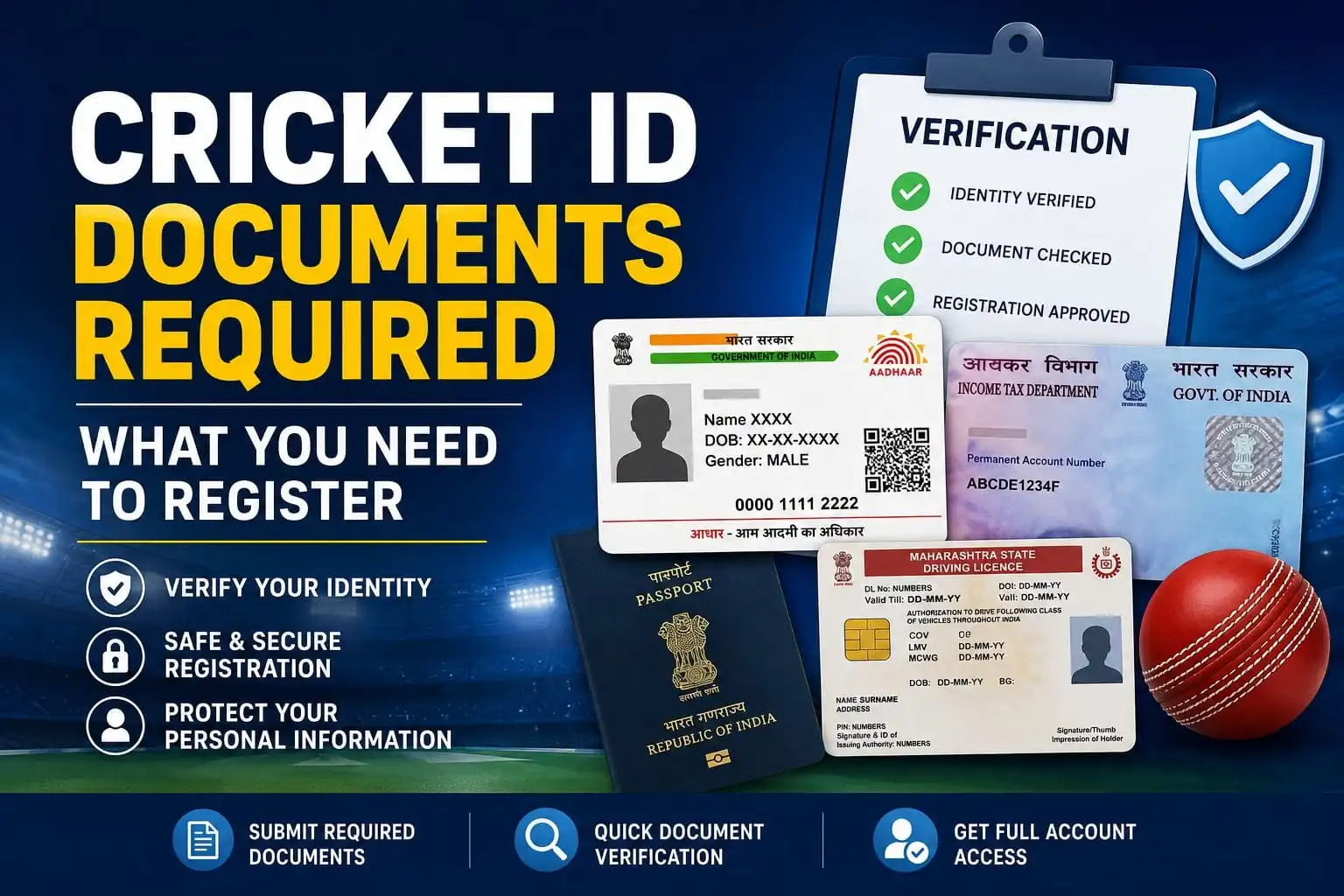
If you’re searching for the documents required cricket ID registration, you’re probably wondering what information you’ll need before creating an account. Many people are unsure whether a mobile number is enough, whether identity verification is mandatory, or why some providers ask for additional documents while others don’t.
The answer depends on the platform’s verification process and its security policies. Some providers allow basic registration with only a mobile number, while others require Know Your Customer (KYC) verification before enabling all account features.
This guide explains the most commonly requested cricket id registration documents, why they’re needed, how the verification process usually works, what warning signs to watch for, and how to protect your personal information before sharing any documents.
Understanding the Documents Required for Cricket ID Registration
The documents required cricket ID providers ask for may vary depending on their verification process and security policies. Before creating an account, it’s important to understand that there is no single industry-wide document requirement. Different providers follow different onboarding processes depending on their internal verification policies.
In general, providers request documents for three main reasons:
- To verify the user’s identity
- To reduce fake or duplicate accounts
- To improve account security and recovery
If you’ve already read our guide on Cricket ID Registration, you’ll know that registration requirements often vary from one provider to another. Similarly, our guide on Cricket ID Verification explains why some users may be asked to complete additional verification after registration rather than before.
For most users, document verification becomes necessary only when a provider needs to confirm identity or resolve account-related issues.
Who Should Read This Guide?
This article is useful if you are:
- Creating your first cricket ID
- Comparing different providers
- Unsure whether KYC is required
- Concerned about sharing personal documents
- Looking for safer registration practices
- Trying to avoid fake agents and fraudulent websites
Understanding the process beforehand can help you avoid unnecessary delays and reduce the chances of sharing sensitive information with unreliable sources.
A Real-Life Example: Why It’s Important to Understand Why Documents Are Requested
A few days ago, one of our friends shared an experience that reminded us why it’s always a good idea to understand the verification process before sending personal documents.
He was registering for a Cricket ID for the first time when the person handling the registration told him there might already be another account linked to his mobile number. To “verify” that there were no duplicate accounts, he was asked to send photos of his Aadhaar card and PAN card on WhatsApp.
Since he had never registered before, he assumed this was a normal step and shared the documents without asking any questions. Later, when he tried to check the status of his verification, he couldn’t contact the same person again. Although nothing else happened, the experience made him realize that he should have first understood why both documents were required and whether he was communicating through an official channel.
This story doesn’t mean that every request for KYC documents is suspicious. Many genuine providers ask for identity verification as part of their registration process. The lesson is simply to stay informed. Before sharing Aadhaar, PAN, or any other personal document, understand why it’s being requested, verify that you’re dealing with an official representative, and make sure you’re comfortable with the provider’s verification process. A few extra minutes of checking can help you make safer and more informed decisions.
How Cricket ID Verification Usually Works
Although registration processes differ, the overall workflow is fairly similar across many providers.
Step 1: Basic Registration
Most providers begin with basic information such as:
- Mobile number
- Name
- Preferred username
- Communication method (WhatsApp or phone)
Some providers may activate a limited account at this stage.
Step 2: Identity Verification
The following are the most common documents required cricket ID providers may request during registration or KYC verification.
Common examples include:
| Document | Purpose |
| Aadhaar Card | Identity verification |
| PAN Card | Identity confirmation |
| Passport | Identity verification |
| Driving Licence | Proof of identity |
| Voter ID | Alternate identity proof |
Not every provider requests every document. Requirements vary depending on internal policies.
Step 3: Document Review
The submitted documents are reviewed to confirm that:
- The document appears genuine.
- Details are readable.
- Information matches the registration details.
- Images are clear and complete.
If the uploaded image is blurry or cropped, users may be asked to submit it again.
Step 4: Account Confirmation
Once verification is completed successfully, the account may receive full access depending on the provider’s process.
Some providers notify users through WhatsApp, SMS, or email.
Common Cricket ID Registration Documents
While there is no universal checklist, these are the documents most frequently requested during registration or KYC.
Aadhaar Card
One of the most commonly accepted identity documents in India.
Usually requested because it contains:
- Name
- Photograph
- Date of birth
- Unique identification number
If you choose to share your Aadhaar, make sure you understand how the provider stores and protects your information.
PAN Card
Some providers accept PAN as an identity verification document.
It helps verify:
- Name
- Permanent Account Number
- Identity consistency
Passport
A passport is widely accepted as government-issued identity proof.
It may also be preferred by users who are not comfortable sharing Aadhaar.
Driving Licence
A valid driving licence can often serve as an alternative identity document.
Ensure the licence is:
- Valid
- Clearly visible
- Not expired
Voter ID
Some providers also accept a Voter ID card during verification.
Again, acceptance depends entirely on the provider.
Why Do Providers Ask for KYC Documents?
Many users wonder why document verification is necessary at all.
Some common reasons include:
- Preventing duplicate accounts
- Reducing fraudulent registrations
- Improving account recovery
- Confirming identity during support requests
- Maintaining internal security standards
Verification also makes it easier for customer support teams to verify ownership if someone loses access to their account.
However, legitimate providers should clearly explain:
- Why documents are needed
- How they are stored
- Who has access
- When they may be deleted
Transparency is an important sign of a trustworthy service.
Choosing a Reliable Cricket ID Provider
Not every provider follows the same verification standards.
Before sharing any personal documents, evaluate the provider carefully.
1. Clear Verification Process
Reliable providers explain:
- Which documents are required
- Why they are required
- How long verification usually takes
Avoid providers who suddenly request additional documents without explanation.
2. Responsive Customer Support
Good customer support should be able to answer questions such as:
- Why is verification pending?
- Which document formats are accepted?
- What happens if verification fails?
- How can incorrect submissions be corrected?
You can learn more about identifying trustworthy services in our guide on Trusted Cricket ID.
3. Transparent Communication
Professional providers usually communicate through official channels rather than constantly changing phone numbers or social media accounts.
If you’re contacting someone through WhatsApp, compare the details with the provider’s official Cricket ID WhatsApp Number page whenever available.
4. Secure Document Handling
Before uploading documents, check whether the provider mentions:
- Privacy practices
- Data protection
- Secure uploads
- Responsible document storage
If none of this information is available, consider asking questions before proceeding.
5. Platform Reputation
Spend a few minutes researching the provider.
Look for:
- Independent user reviews
- Consistent customer experiences
- Transparent communication
- Established online presence
Remember that reviews should never be your only decision factor, but they can help identify recurring problems.
Warning Signs to Watch For
Be cautious if a provider:
- Asks for unnecessary personal information.
- Requests documents before explaining the process.
- Refuses to answer verification questions.
- Frequently changes contact numbers.
- Pressures you to act immediately.
- Uses unofficial communication channels.
- Cannot explain how your documents will be used.
These signs do not automatically indicate fraud, but they should encourage you to investigate further before sharing sensitive information.
Step-by-Step Cricket ID Registration and Verification Process
Although every provider follows its own workflow, users can generally expect something similar to the following:
Step 1
Choose a provider after comparing reputation, support, and verification policies.
Step 2
Complete the initial registration using basic contact information.
Step 3
Wait to see whether identity verification is required.
Step 4
If requested, upload the necessary cricket id registration documents.
Step 5
Wait while the provider reviews the submitted documents.
Step 6
Respond promptly if additional clarification or a clearer document image is requested.
Step 7
Receive confirmation after successful verification.
Step 8
Keep your registered contact information updated so customer support can assist if needed.
If you’re comparing different services, our articles on Online Cricket ID, Cricket ID Provider, Online ID Provider, and Cricket Exchange explain how different platforms approach registration and account management.
Understanding the documents required cricket ID registration process can help you prepare the correct documents and avoid unnecessary delays.
Tips to Protect Your Personal Documents
Sharing identity documents online requires caution.
Follow these practical safety tips:
- Verify you’re using the provider’s official website or contact details.
- Never send documents to unknown social media profiles.
- Avoid sharing documents in public groups.
- Read the provider’s privacy policy if available.
- Ask why a document is required before uploading it.
- Do not share OTPs or passwords.
- Keep copies of your submissions for reference.
- Contact customer support if anything seems unusual.
A few extra minutes of verification can significantly reduce your risk of identity misuse.
Common Verification Issues and How They Are Resolved
Many verification delays happen because of simple mistakes rather than technical problems.
Here are some common examples:
| Issue | Possible Solution |
| Blurry image | Upload a clearer photo |
| Cropped document | Submit the full document |
| Name mismatch | Update registration details or contact support |
| Expired ID | Use a currently valid document |
| Slow verification | Contact official customer support politely |
Patience is important. Verification times vary depending on the provider’s workload and internal review process.
Frequently Asked Questions
What documents are required for cricket ID registration?
The documents required cricket id registration usually depend on the provider. Commonly accepted identity documents include Aadhaar Card, PAN Card, Passport, Driving Licence, or Voter ID, although requirements vary.
Is KYC mandatory for every cricket ID?
No. Some providers only require basic registration, while others request KYC before providing full account access.
Can I register using only my mobile number?
Some providers allow initial registration with a mobile number, but additional verification may be requested later.
Why are cricket ID KYC documents requested?
Providers often request cricket id kyc documents to verify identity, improve account security, reduce duplicate registrations, and assist with account recovery.
How long does verification usually take?
Verification time depends on the provider. Some reviews are completed quickly, while others may take longer if additional checks are required.
Which document is most commonly accepted?
Aadhaar Card is commonly requested in India, but many providers also accept PAN Card, Passport, Driving Licence, or Voter ID.
Is it safe to upload identity documents?
It depends on the provider’s security practices. Only share documents through official communication channels after confirming why they are needed.
What happens if my documents are rejected?
Most providers explain the reason and allow users to upload clearer images or alternative identity documents.
Can I update my documents later?
Many providers allow users to update their information by contacting customer support, although policies differ.
How can I identify a trustworthy provider?
Look for transparent verification policies, responsive customer support, official contact details, clear privacy practices, and a consistent reputation before sharing personal information.
Register Carefully and Protect Your Personal Information
Understanding the documents required cricket id registration process helps you make better decisions before sharing sensitive information. While many providers request identity verification to improve security and reduce fraudulent registrations, document requirements are not identical across the industry.
Take time to compare providers, review their verification process, confirm you’re using official communication channels, and understand how your personal information will be handled. If anything seems unclear, ask questions before submitting your documents.
Being informed is one of the simplest ways to protect your privacy, avoid scams, and choose a provider that communicates transparently throughout the registration and verification process.